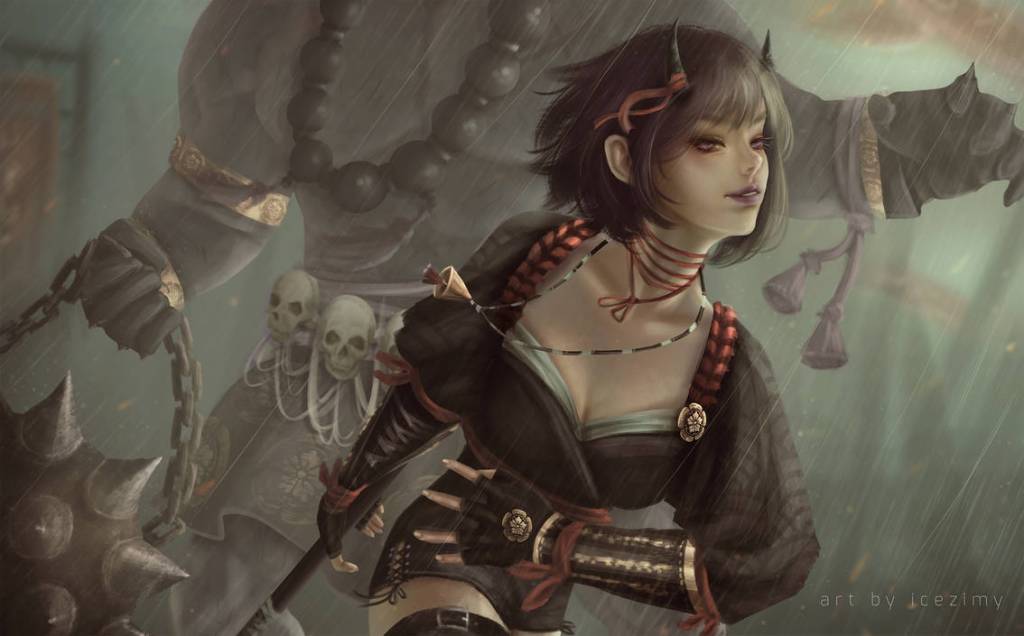
“Team” by Icezimy
Wetting The Appetite for Japanese History & Culture
[August 10th, 2021]: I added a couple of extra links to the various pieces and artists I mentioned for your convenience. Now enter the article…
Today’s piece is a bit more complicated than some of the others I’ve done thus far, so this should be a good opportunity to analyze more deeply. This piece is by “Icezimy” another artist that I’m working with directly, whom you can find here (will show you all of her socials.) Icezimy is an artist that I originally found on DeviantArt in my recommended list while I was admiring “theCecile’s” work, so we have her and the platform to thank for this collab. Her style stuck out to me I’d say because of her use of a very dreamy and soft lined technique and a nice kind of blended painting style. Pieces like this one, her banner art, and another piece “NomNom” made me appreciate her sense of humor and general vibe.
The first obvious thing to notice about this piece is the samurai motif. Talking with Icezimy she mentioned that she took a lot of inspiration from a documentary she’d watched, and in particular some of the lore around Oda Nobunaga or the “demon daimyo.” Oda in particular is where she got the crest design, as it’s a representation of the “Oda Mokko” and also the idea to make the characters a bit devilish looking. The choice of weapon and some clothing design elements were borrowed from the historical “ona-musha” who were the rare, elite offensive female warrior of Japanese history and general samurai culture. The naginata in her hand was generally the weapon of choice for female warriors in Japan, and while usually associated to my understanding, with the defensive female warrior, or the ona-bugeisha, it fits quite well in this piece.
Digging in to some of the other details, I want to turn our attention towards the right armguard. Here Icezimy’s technique and painting style really shines through with how she handles representing the material. She uses a very subtle contrast between light and darkness and gentle movement in the lines to give the impression that the material is tightly wrapped around the forearm. Although this attire is not intended to be a historically accurate representation of a samurai, I think Icezimy’s interpretation of the armguard or the “han kote,” I believe it’s called, is really, really on point here. Another thing I really enjoy about the design of her samurai character is the way she represents the red adornment on her clothing. It has just the right amount of bright red, yet is desaturated in such a way that it pops without overpowering the piece visually. Beyond the cutting edge of the naginata, I can imagine that the red adornments and golden Oda Mokko crests are the last thing her opponents see as they “head down the river.”
The reason that I dubbed this article “arrogant naivety” is because the grip the warrior has on her naginata strikes me as much too loose for an experienced combatant, and the smug look on her face, with her chin slightly upward gives a prideful impression. The reason this is important isn’t because the depiction seems misplaced or something, but because it tells a story that this samurai is probably inexperienced and may be stepping on to her first real battlefield. Talking with Icezimy she mentioned that she was sort of going for this feel, and I think these elements do a great job of telling the story she had in her head.
Next, let’s talk a little about our orc buddy behind the samurai. The first couple things we notice are the orbs around his neck, his battle ready stance and his ball and chain. According to a quick search, I guess the orbs around his neck that many of us may be used to seeing in certain Asian media are called baoding balls. Apparently they are something like chinese health balls, that when squeezed are supposed to support health by pushing acupressure points in the hand. I suppose wearing them around the neck is meant to support vitality. That may be completely inaccurate but if true, that’s pretty interesting. [Note: I’m stupid this is supposed to be inspired by a Japanese prayer necklace, don’t mind me.] The skulls around the orc’s waist support the devilish theme mentioned before. My understanding is that this orc was also inspired somewhat by the famous “oni” demon, but I’m unsure as to whether the skulls have any deep mythological meaning. However being a man who enjoys a good ol’ fashioned mace, let’s talk about the details of the orc’s weapon. I think our artist here did an excellent job of giving the mace a metallic look without too much luminescence, just the right amount of light hitting it, and it’s balanced to almost look like a sharpened piece of lead (in a good way.) Sometimes metal or iron can be a bit too shiny and can throw off the dynamic of the piece, but I think a nice balance was struck here.
Lastly, let’s talk about what really brings this piece together, the background and setting. Firstly, the rain and the colors in the sky work perfectly to set the scene of the battlefield. One thing I really like about the tone of this picture is that the rain and the grays and moodier colors are juxtaposed with the smugness of the samurai and the defiance of the orc. Additionally we see a bit of splashing and fog created by the rain bouncing off the characters which really makes the rain apart of this picture. The reds mixed with the grays in the sky give the perfect amount of color, and I feel like the sunset represents the beginning of the battle or the end of sunshine and rainbows (quite literally.) Off to the right we can see wood pillars coming out of the ground, perhaps wreckage or thrown together defensive structures, and on the right we can see a banner that fully ties the story together. The way that Icezimy uses occlusion and blurs images as they move away from the foreground is really powerful in this piece and helps create distinct layers. Almost like reading a comic, this picture encourages the eyes to flow with a certain rhythm. From the clothing, stylization, expressions of the characters and the environment we can piece together what’s happening and almost infer a dialogue from what we’re being shown. For me, this piece not only raises curiosity about Japanese culture and mythology but makes one wonder, as many great pictures do, about the moments that come after it.
 AnimeExplicated
Leave a comment