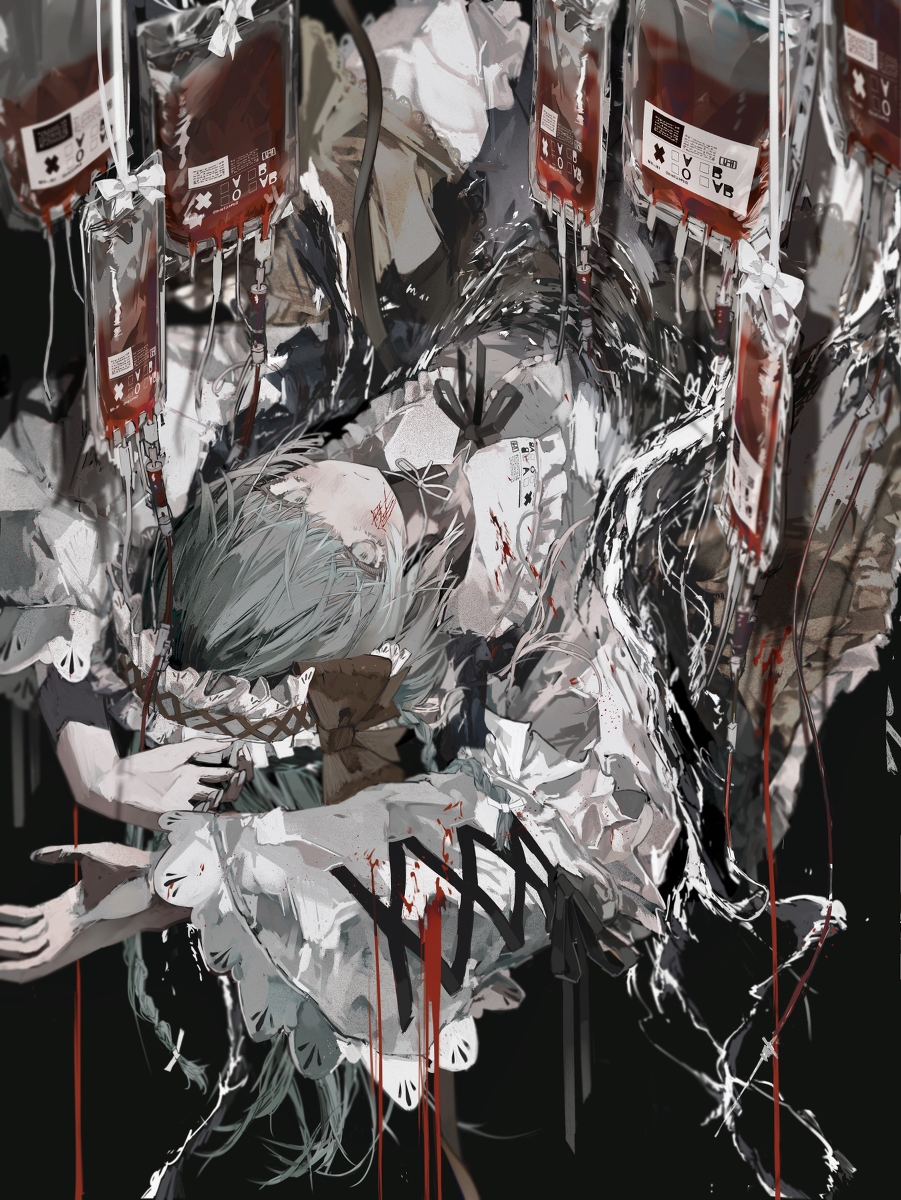
Today, I’ve selected another beautiful piece by Tekito-Midori as a study-case for a few high-impact compositional elements. If I haven’t made it clear enough, I’m a big fan of Midori’s work and view her as an invaluable creator, particularly of aesthetic complexity.
When I select pieces to review, I seek out complexity or uniqueness that gives me something interesting to elucidate. This piece, as no exception, conveys its excellence via complicated imagery that invokes an array of distinct perceptions. This is not the sort of piece that is figured out at once, but something that constantly engages the imagination.
As our primary mind-stretcher, I wanna dive into the specifics of how ambiguity is built into this piece. The elements I’ll focus on contribute tremendously to coaxing the viewer to be truly invested in artwork. There are 3 key things I want to expand on, that really make this work so powerful.
The first element is the use of blood in illustration. Blood is often used in abstract work, and is typically considered a form of highlight, but its uses run much deeper. Not only is the color itself a powerful source of contrast, the concept of blood is a weapon to give your artwork a compelling story. Blood is the essence of life, and has both an imperative biological significance, and gets the viewer asking “why” questions. In this piece, right away you form a story around all the questions that pop up. You may wonder if the character is injured, if they are on their way to a hospital, or if there is some metaphorical meaning. Just by adding this element the viewer puts a mood, setting or deeper narrative to the work, without any words exchanged.
Gravity is another element crucial to this piece. Regardless of setting, the brain gets to work figuring out “what” is happening in the picture using various clues. My title for this review in fact, was inspired by my impression that this work depicts a kind of weightlessness. Not quite like being hung upside down or laying on something, but being stuck in the frames before a fall. While certain parts of the character, like bits of the hair and clothes, tell us that some part of them is hanging, the orientation of this painting makes it hard to tell. Things like lines of movement used in manga, or the “flow” of certain elements can massively alter the implied setting or orientation of a picture. We have a certain intuition about what a character should look like in a windy setting or underwater, and the implications of gravity, while less obvious, are not much different.
For the final element, I want to return to the idea of complexity with specific attention to setting. Provided the orientation of the character were different, or the “where” of this image were more explicit, that would completely change the effect of the other elements. The real power of these elements is not unlocked individually, instead they work in conjunction to create a beautiful, mysterious and thought-provoking piece. Additionally, Midori brings complexity in with lots of smaller details in the environment, but does not allow them to detract from the story. Though there are many nuances that add flavor and rev up our imagination, none quite ruin the cohesiveness of the piece due to the harmony of composition.
I love this piece not only because of how it masterfully takes advantage of the aforementioned elements, but also for it’s ability to take me through the portal and really turn on my imagination. Basically, you did a damn good job Midori.
 AnimeExplicated
Leave a comment