
Wishful thinking is the archnemesis of progress. The lies we tell ourselves, not external misinformation or misplacing our world-class personal trainer, are the biggest obstacle to living our daydreams.
It is true that sacrifice and prioritization are necessary to achieve real results, but the reason no one wants to be told this is because most people give bad and confusing advice on HOW to go about making these decisions. Jerry Jenkins, a world-class writer and multi best-selling author, who has greatly impacted my writing, often talks about how he personally navigated working to become phenomenal. He knew he wanted to be an exceptional author, but he also knew that when his kids were at home and awake he would not sacrifice time with his family and children for his dream. So he woke up earlier or stayed up later clanking away on his typewriter at his makeshift couch desk to turn his vision into reality.
I may have used a writer and not a painter to express the point, but the key lesson remains the same. What are you really willing to compromise to achieve your goals? I can speak with some authority on this as like many of you I did not grow up rich, I have responsibilities, finite energy and time, and a myriad of things I’d love to “get around to.” We all have the same 24 hours, the key is how we allocate them.
If you want to be a legendary virtuoso painter, but find you only have 10 hours a week to paint, it’s unlikely you’ll be the next Michelangelo in 3 years. Our lives do not operate based on the “march of progress.” If we don’t very actively make systems and key decisions to put in the reps and get after it, it ain’t gonna happen. But of course we all know this. You can have anything you want, but probably not all at the same time.
On another website of mine, in a galaxy far, far away I’ve spoken of an idea I call the PID rule. Essentially you ask yourself, “Do I like the idea, process and destination of a given thing?” This comes in great handy when assessing if something is worth having as a big rock in your life. Coming back to the painting example, if we daydream about being a virtuoso painter, and repeatedly find painting relegated to a mere pebble in our jar of rocks, displaced by other obligations and activities, we can kiss our big goals goodbye.
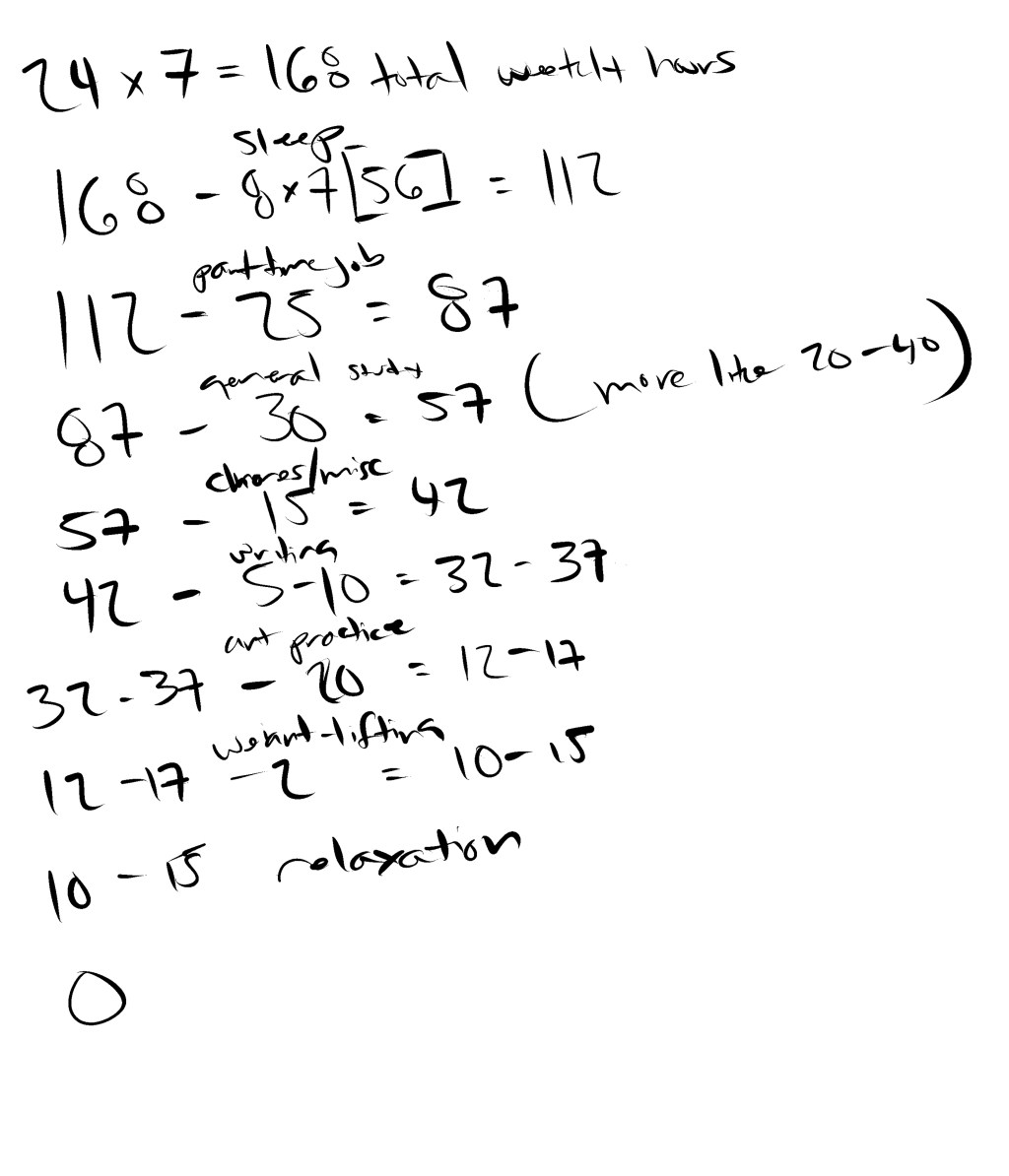
One exercise that I’ve found incredibly useful is to grab a whiteboard or piece of paper and examine how I really spend the hours in my week. Here’s an example (and before you run away let me contextualize a few things)
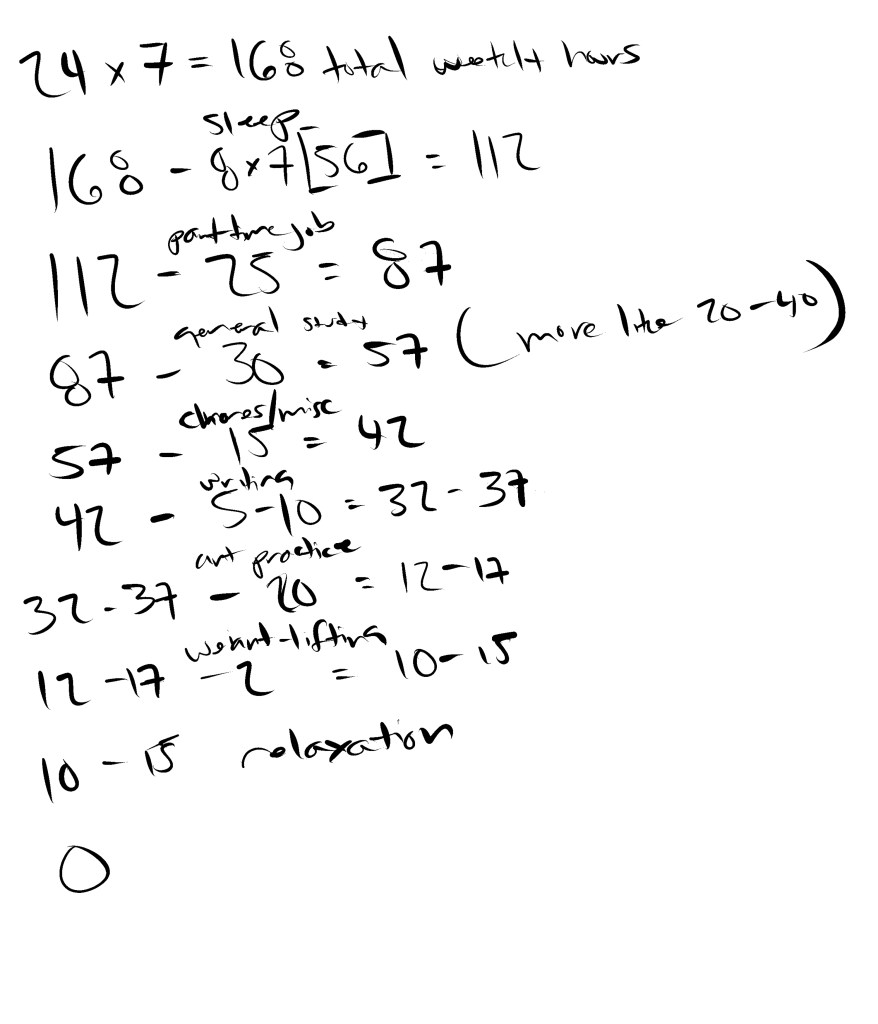
A few points of clarification. This of course is an idealized week if I somehow had the energy to do everything I wanted to do. I’ve had times where I’ve worked 90 hours a week and times where I’ve worked 20. This is not to impress or be unrealistic but rather to illustrate a few really important points.
1) 112 hours is a lot of time and most of us waste a tremendous amount of it.
2) Many people say they want to be great, but don’t actually take the time to figure out when all this training is gonna happen. There is no change without a change in routine.
3) Energy and enthusiasm are weakly related, and life happens whether we’d like it to or not. Turns out the universe, the culture and most people most of the time really don’t give a flying fuck about “our” priorities.
But of course there are even more insights that are super important and yet underappreciated.
There is almost no reason to sleep less unless someone is dropping bombs on your house at 2am, because the hit to your performance and creativity is non-linear. 45 fewer minutes of quality sleep might make you half as creative as you would’ve otherwise been. “I’ll sleep when I’m dead” is a fantastic way to get zero quality work done.
“I don’t have time” is almost without exception untrue. What we really mean is we don’t have enough energy, or just really don’t want to do something. The self-talk here is actually really important. Saying we don’t have time as our default will begin to make it psychologically true, even though it’s not actually true. Invisible scripts are a real threat.
Perhaps the least obvious but most important insight from an exercise like this is actually why thinking about input in terms of hours or volume is so deeply flawed. While this poster sort of illustrates my commitment level to various things, it spends no time evaluating the output of my time spent. The reason I like this exercise most of all is because it breaks the death-grip conventional thinking has on many of our minds. There is an old adage from the industrialists that says something like “8 hours work, 8 hours sleep, 8 hours for what we will.” Though it leaves out commute and time lost to transitional and miscellaneous things, the burning question is really “where the hell do the other 8 hours go?”
The last insight is why I spend relatively little time writing, compared to the amount of time I spend on “general study.” I’m not in college so this is actually time spent reading, listening to informational podcasts or conversations and anything that hopefully makes me smarter, wiser or gets me thinking differently about something. The more experience that I get writing and cultivating flow states, the less time I spend because I can produce quality writing (I’ll let you be the judge) without staring at a blank page for extended periods of time or being paralyzed by perfectionism. Additionally, if I actually have something to say, I don’t need to struggle to yank something out of myself.
Moving past this exercise, focusing on output rather than input can also be extremely helpful. If we make the goal, produce 2 drawings with a specific focus (composition, perspective, anatomy etc), or produce 5 crappy pages a week, it changes how you think about work. Instead of thinking about time, your are incentivizing yourself to remove friction and unnecessary steps to achieve the desired result more efficiently. But of course this is classic Tim Ferriss and Peter Drucker so I won’t beat the dead horse here.
If you are committed, and willing to turn off notifications and put your phone in airplane mode to get after it, if you’re willing to make something a big rock by tossing out some pebbles and sand, you’re well on your way to real progress. As for more resources on how to be more effective, I highly recommend something like the “4 hour workweek” by Tim Ferriss (bad title, fantastic book), probably anything by Peter Drucker but in particular “Managing Oneself” or the article I wrote previously on 10x’ing creativity.
I wish great luck to all of you that take on the never-ending journey to mastery and being a better version of yourself. Hope this was helpful. Cheers~
 AnimeExplicated
Leave a comment